

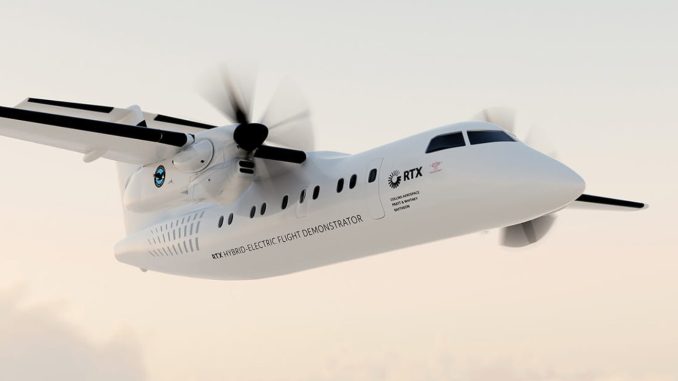
RTX has given more information about its Hybrid-Electric Flight Demonstrator experimental propulsion system for a regional aircraft. It will pair a thermal engine with an electric motor – and, the team hopes, tap into a new era of fuel efficiency for aviation.
“The project is supported by the Canadian federal government and provincial government of Quebec along with a range of partners across industry and academia,” said the company in a March 3 press release. “It also reflects RTX’s company-wide approach to innovation; it combines an advanced thermal engine from Pratt & Whitney Canada, a 1-megawatt electric motor from Collins Aerospace, and a 200-kilowatt-hour battery system from the startup H55, backed in part by RTX Ventures, the company’s venture capital arm.
The goal of the project is to show a 30% improvement in fuel efficiency compared to today’s most advanced regional turboprops. The team also hopes the project will show what’s possible in designing future aircraft.
The demonstrator combines an advanced fuel-burning thermal engine from Pratt & Whitney with a 1-megawatt electric motor built by Collins Aerospace. A special gear system connects the two and keeps the propeller turning, whether the power comes from the engine, the motor, or both. “That question depends on the stage of flight,” says RTX. “The thermal engine will power the plane during cruise, and the electric motor will do most of its work by helping with the taxi stage, as well as the power-intensive flight modes of takeoff and climb.The motor will get its energy from a battery pack with a 200-kilowatt hour capacity – enough to power the average American home for nearly a week.
“Thermal engines convert only about 30% to 40% of their fuel to useful energy – the rest is lost to heat or friction between moving parts. Electrical systems are more efficient, converting more than 90% of their energy into mechanical power.”
“People don’t want to fly an empty plane filled with batteries. What we’re interested in is reducing the energy per passenger-mile,” said Rémi Robache, a Pratt & Whitney program manager for electronics. “It’s having the most efficient system that consumes the least fuel and the least electricity possible. It’s about minimizing the energy that you need to bring a passenger from A to B.”
Someday, new, lightweight battery chemistries will drastically reduce weight. But for this project, the team had to find other ways to make the engine lighter. The Collins Aerospace team worked with the RTX Technology Research Center to use novel materials for lighter parts, and they incorporated wide band-gap semiconductors and magnet technologies that provide more power than traditional solutions without adding weight.
“Hybrid-electric propulsion for a regional aircraft requires thousands of battery cells linked together operating at high voltage levels. That creates a risk of overheating or electrical arcing, where electricity jumps from its path and forms a miniature lightning bolt between the battery and something next to it. Having to solve for arcing is a relatively new problem in aviation, Venditti said.”
“For help on the battery system, Pratt & Whitney enlisted H55, a Swiss company with backing from RTX Ventures. The demonstrator’s battery is based on technology H55 has already put into flight on smaller aircraft, including an all-electric two-seater. The two first prototypes of H55’s aircraft propelled by the company’s fully electric propulsion technology. Pratt & Whitney is using a modified version of H55’s battery system for its hybrid-electric demonstrator that will fly on an experimental De Havilland Canada Dash-8 regional turboprop aircraft.”
For more information
https://www.rtx.com/news/2026/03/03/rtxs-hybrid-electric-plane-is-one-step-closer-to-the-sky
(Image: RTX)