

By Philip Butterworth-Hayes
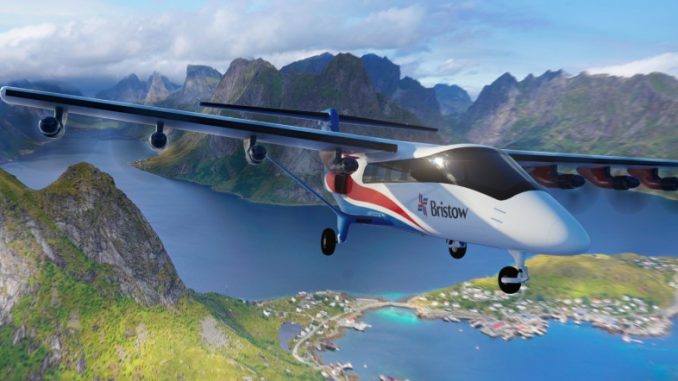
Of all the places on Earth to host a real aviation revolution, Norway is not perhaps an obvious first choice. But in an April 2026 announcement – which deserved a lot more publicity than it got – Bristow, Electra, Avinor and the Norwegian Civil Aviation Authority reported that next year they would be launching test flights of a hybrid electric regional airliner between airports in the north of the country,
Electra is based in Virginia, USA and its hybrid/electric Ultra Short aircraft operates from take-off and landing areas the size of a football pitch. It is likely to be the world’s first quasi-electric airliner, though perhaps describing it as an “airliner” is a bit strong. It seats just nine passengers and their luggage and has a range of 1,100 nm (with 45 mins reserve).
Still, it’s a start.
The Ultra Short was also chosen by the US Federal Aviation Administration (FAA) in March as one of the successful winners of Electric Vertical Takeoff and Landing and Advanced Air Mobility Integration Pilot Program (eIPP), a programme which President Trump has launched to enable the USA to catch up with China in the electric aviation race. The concept behind the eIPP is to start experimental flights in the next few months with a clear pathway to commercial operations asap.
In the USA, the Ultra Short will fly in the more clement climes of Florida, connecting cities there in a regional network and connecting other towns in New York, New Jersey and Pennsylvania.
It has become clear to everyone by now that in the world of advanced air mobility the only companies likely to make it to market, and then scale, are those which enjoy the direct and indirect political backing of national governments. Industry alone cannot afford the price of certifying new electric technology, or survive the timescales required for its certification, which invariable involve delays and missed deadlines.
So what makes Norway a particularly important player in this market is the government’s commitment to regional electric air services. Back in 2020 the Norwegian government developed its regional electric aviation strategy along with partners like Widerøe, SAS and the Zero Emission Resource Organisation. Key targets include operating the first scheduled domestic electric flights by 2030 and achieving fully electrified domestic aviation by 2040, thereby cutting emissions by 80% compared to 2020. It is on course to meet these targets.
Electra is not the only electric airliner game in town. At AERO Friedrichshafen 2026, France’s AURA unveiled the new cabin configurations for its ERA, a hybrid-electric 19-seat regional aircraft which plans to enter regional airline service by 2030. The company came to the show buoyed by the support of President Emmanuel Macron, who at the start of April identified 150 projects nationwide as “industrial cathedrals” across France, with a new AURA factory in Toulouse being one of them.
Bigger still is the Heart Aerospace ES-30, a 30-passenger hybrid-electric aircraft with a 200km all-electric range and up to 400km in hybrid mode. It is expected to enter service by 2028. Its Swedish developers upped sticks in April last year and moved from Gothenburg to Los Angeles to be closer to potential investors – the development programme is partially funded by a USD 4.1 million grant from FAA’s Fuelling Aviation’s Sustainable Transition (FAST) programme.
And then there is cargo. In February this year Air New Zealand completed a four-month-long flight demonstration campaign with Beta Technologies’ Alia CX300 electric aircraft as part of its Mission Next Gen Aircraft to replace or supplement traditional regional turboprops as 60% of its regional flights are under 350km. The start of commercial services will depend on when the aircraft is certified by the FAA and the Civil Aviation Authority of New Zealand – but the airline has said services could start later this year.
In the world of electric airliners, predicted entry-into-service times, government visions, funding announcements and even orders count for little. What matters is battery efficiency. Those with intimate knowledge of these matters are looking for a target of 500 Wh/kg to make the weight/power ratio of aviation batteries make sense for electric airliner commercial operations. And we are slowly getting there, say the experts. Advances in solid-state batteries, high-silicon content, and Lithium-Sulfur (Li-S) technologies as well as thermal management systems and advanced battery management systems suggest we are four or five years from this target.
According to recent NASA research, we will see “nominal cell level specific energies for rechargeable batteries of 489 Wh/kg by 2030, 638 Wh/kg by 2040, and 764 Wh/kg by 2050.” Importantly, the research is based not just on finger-in-the-air forecasting but actual historical data and close analysis of current research.
For the aviation industry this quiet revolution in electric airliner technology is fantastic news. The industry has been struggling to convince anyone that the story it tells about how it going to reach net zero by 2050 is realistic. This is supposed to be a three-stage evolution. First, use current technologies more efficiently (marginal at best). Second, slowly replace fossil fuels with sustainable aviation fuel (there is not enough). Third, develop a whole new generation of airframes and engines which radical designs and fluids (flying wings and hydrogen engines – who knows? Might work – but it will be someone else’s problem then).
There still remain huge question marks over just how far and fast electric airliner technology can advance and perhaps the biggest question now is: if it’s so good why isn’t China working at pace in this area? And there is the major caveat that not even the most pugnacious electric aircraft proponent is suggesting battery powered airliners with three hundred passengers will fly across the Atlantic or the Pacific.
But a 764 Wh/kg battery is transformative, especially if it is supported by hybrid energy systems – so who knows?
We have to start somewhere and there is no tougher operating environment than the harsh conditions of Northern Norway, where remote communities reply on aviation for essential services, to test the resilience and reliability of this new tech. The revolution starts here.
This article first appeared earlier this month in the Aviation Intelligence Reporter and has been reproduced with kind permission of the publishers.
(Image: Electra)