

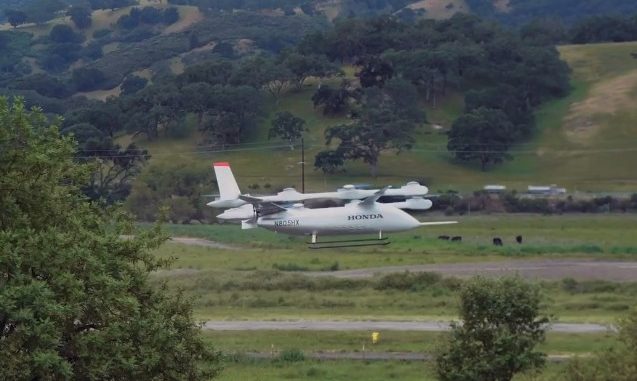
According to Atsushi Ogawa, Chief Operating Officer at Honda R&D, in a Linkedin post:
“On April 1, a flight test was conducted in San Luis Obispo, California, where a full-scale technology demonstrator weighing approximately 7,000 pounds successfully completed its first flight, lasting about 90 seconds. As shared at last year’s Dubai Airshow, Honda is steadily advancing into the full-scale flight testing phase. This first full-scale flight builds on research and development efforts that began in 2020, along with more than 400 flight tests conducted using subscale models. With this milestone, development advances into the full-scale validation phase, where the foundational technologies of eVTOL are being verified at real scale.
According to a briefing at the 2025 Dubai Air Show the Honda eVTOL is equipped with eight rotors for vertical take-off and landing and two rotors for propulsion. It features a gas turbine hybrid power unit which will give the aircraft a range of 400 km. “Honda is the only company in the world that has obtained U.S. Federal Aviation Administration (FAA) certification for both the airframe and the aircraft engine, conducting HondaJet business,” said the company website. “Our know-how in the FAA certification process will enable us to increase the efficiency of eVTOL development and speed up the delivery of Honda eVTOL to our customers. Moreover, Honda will make a great use of its expertise in lightweight structures and production technologies unique only to aircraft.”
“F1™ technologies, both tangible and intangible, have also been incorporated into the development of Honda eVTOL, including F1™ power unit technology applied for the ultra-high rpm generator, as well as the simulation analysis technology and facilities for aerodynamic development. Racing chassis technologies are also applied to Honda eVTOL as there are many similarities in aerodynamic phenomena because the speed range and airflow turbulence eVTOL needs to manage are closer to those of F1™ machines than of passenger airplanes. Moreover, Honda also has time-proven hybrid technologies as well as safety technologies such as Honda SENSING technologies. Participation of Honda engineers with experience in various areas including HondaJet, F1™, hybrid vehicles and safety and driver-assistive technologies, is enabling the project team to pursue the development of eVTOL unique only to Honda.”
For more information
https://www.linkedin.com/in/atsushi-ogawa-18219a19/