

AirIndex and Aeroberm™ (a Skyportz Australia company) have announced a strategic partnership combining AirIndex’s audit of U.S. vertical-lift infrastructure with Aeroberm™ — the patented modular vertipad system — to address one of the least-discussed but most consequential barriers to advanced air mobility deployment: the gap between where helicopters land today and where eVTOL aircraft can safely land tomorrow.
“AirIndex’s independent analysis of the FAA’s Airport Master Record — the authoritative federal database of U.S. heliports — has found four systematic failures in the national landing infrastructure record,” said the companies in a joint press release. “Of the 5,647 registered U.S. heliports, 98.5 percent have never been independently field-inspected. The owners simply supplied the data. More than 1,121 hospital helipads operating today have no FAA registration on file within a nautical mile. Facilities have moved — for example, from ground to rooftop — while the federal record updated only partially, leaving recorded elevations, approach geometry, and obstruction data quietly drifting from physical reality. And in some cases, the coordinates are simply wrong: one Nashville heliport has been plotted 48.5 nautical miles from its true location since 1979.
“The consequence of these failures has been manageable in the helicopter era, where pilots exercise direct judgment about landing surfaces. It becomes acute in the eVTOL era, where automated and semi-automated flight operations assume the landing surface is exactly where the record says it is, exactly the size the record says it is, and clear of obstructions.
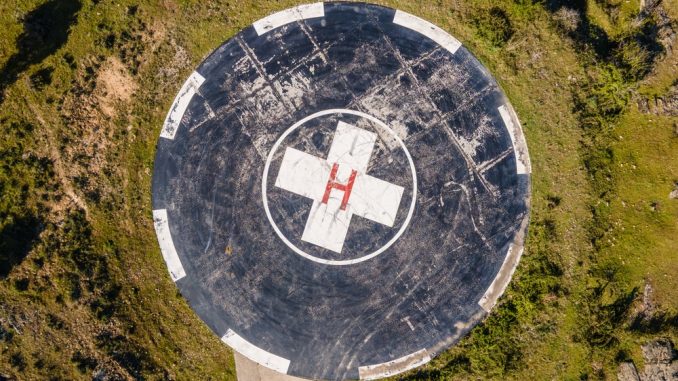
Even where the record is accurate, the infrastructure itself presents a fundamental challenge, say the companies. Of the 5,594 registered U.S. heliports with recorded pad dimensions, the median pad size is just 48 feet. Under FAA Engineering Brief 105A — the current guidance document for eVTOL landing areas — a compliant final approach and takeoff (FATO) area requires a load bearing area approximately double the aircraft reference dimension, putting typical minimums at 100 feet and above. More than half of all registered U.S. heliports are, on the basis of recorded dimensions alone, too small for eVTOL operations under current criteria. And those dimensions sit on top of a record that is 98.5 percent uninspected.
“The assumption that existing helipads will simply become vertiports as air taxis arrive is not supported by the data,” according to the press release. “The infrastructure transition from helicopter-era pads to eVTOL-capable vertipads requires active engineering — not just regulatory redesignation.”
“The federal landing record was built for a world where pilots looked out the window and made judgment calls. Automated eVTOL flight assumes the record is right: the location, the dimensions, the obstructions. Our analysis shows it frequently isn’t. This partnership means we move from measuring the gap to closing it,” said Alan Holmes, Founder & CEO, Vertical Data Group / AirIndex
“The AirIndex research makes something explicit that the industry has been dancing around,” said Clem Newton-Brown, Founder and CEO of Skyportz Australia and creator of the Aeroberm™ patent. “The existing helipad record is not a reliable foundation for eVTOL planning. And even where pads are real, inspected, and correctly recorded, most of them are the wrong size and none of them are engineered for the aerodynamic reality of multi-rotor eVTOL. Aeroberm was designed specifically for this gap. The partnership with AirIndex means we can now identify which existing facilities are candidates for retrofit, what engineering intervention each one needs, and deliver a modular solution that meets the emerging regulatory standard at an affordable cost”
The partnership will initially focus on the United States market, where the AirIndex dataset provides full national coverage, before extending to international markets.
For more information
https://www.aeroberm.com.au/
(Image: Shutterstock)