

By Philip Butterworth-Hayes
It is one of the most talked about questions in aviation – when will the advanced air mobility industry start commercial operations, radically changing low-level airspace operations forever?
It is a three-way race between China, and the Middle East and the USA. At Farnborough this year the major Western electric vertical take-off and landing (eVTOL) manufacturers were there not so much to discuss the start date – generally considered to be the end of this year or more likely the start of 2027 in the USA – but to discuss the wider infrastructure and industry issues involved in starting commercial eVTOL operations
Because for the eVTOL developers speaking at the show, civil certification is only another step along the way to bringing artificial intelligence, autonomy, more capable drone logistics and new forms of hybrid electric propulsion into the market. Archer Aviation, Beta Technologies and Joby Aviation all announced major military autonomous drone logistics programmes at the show, which made clear that civil eVTOL development was an important part, but still just a part, of wider low-altitude airspace industry ambitions.
In March 2026 US Transportation Secretary Sean Duffy and the FAA announced eight proposals were selected as part of the AAM and eVTOL Integration Pilot Program (eIPP). The programme has kick-started the USA’s AAM industry into life, launching eight programmes across 26 states, with the idea of trialling real-world eVTOL and related cargo drone operations as a pathway to initial commercial adoption in the late 2026/2027 timeframe. Beta, Joby and Archer are now rushing to complete the operations and training manuals for the operators and developing the ground infrastructure for the initial operations. As the first flights will be from existing airports and heliports using conventional visual flight rules (VFR), the air traffic management component in the USA is not so much of a priority, at least for the next few months.
During the show the America’s Consortium for Electric Skyways (ACES) was launched – a joint initiative launched by Archer, BETA and Macquarie Capital to build an interoperable eVTOL charging network across more than 250 US sites by 2030. But this system is in direct competition to Joby’s Global Electric Aviation Charging System (GEACS), which features off-board thermal management, dual simultaneous power cables, and a universal electric aircraft charging interface.
Meanwhile, Europe has at last started the serios work of trying to catch up. During the show Honeywell Aerospace announced it will lead Project VERTI GO, a kind of European eIPP, along with Europe’s leading air navigation providers, airports and technology companies, and Vertical Aerospace serving as the project’s piloted eVTOL demonstration partner and Odys Aviation serving as the project’s remotely operated cargo drone demonstration partner.
The project will focus on two pathways, said the company in a press statement, one for eVTOL operations with an onboard pilot and one for remotely operated cargo drone operations. Both project pathways will conduct simulations and demonstrations in European locations. Piloted eVTOL flights, to be conducted by Vertical Aerospace in the south of Spain, will be monitored by aviation authorities to help build trust for future operations. For remotely operated cargo drone operations, the results of these simulations and demonstrations aim to contribute to future standards and regulations for operations in Europe.
According to a Honeywell statement: “Key areas of project VERTI-GO include digital flight planning, vertiports and emergency landing site management, as well as the use of automation to support eVTOL operators and air traffic controllers. Simulations and demonstrations will form the centerpiece of the project, including flight demonstrations using Vertical Aerospace’s prototype eVTOL between Malaga and Marbella in Spain, expected to take place during 2028.”
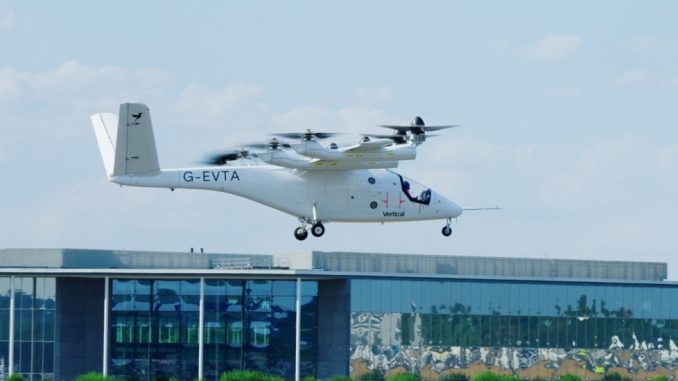
The UK’s Vertical Aerospace flew its V4X eVTOL at the show, while BETA Technologies flew its ALIA fixed wing electric aircraft and announced ClearSky Airlines will start cargo operations in Europe with ALIA electric aircraft in the second half of next year.
During Farnborough Vertical signed a Memorandum of Understanding (MoU) with Saudi Arabia’s General Authority of Civil Aviation (GACA) “to support validation of Vertical’s Valo aircraft type certification, support the development of regulatory frameworks for future electric aircraft operations, and prepare Saudi Arabia’s aviation ecosystem for the safe introduction of eVTOL aircraft,” according to a Vertical Aerospace press release. Alongside this agreement, a separate MoU was signed between Vertical and Cluster2 Airports Company, a Saudi airport operator and with VIC Properties, a Portuguese developer of luxury residential and resort destinations.
(Image: Vertical Aerospace)