

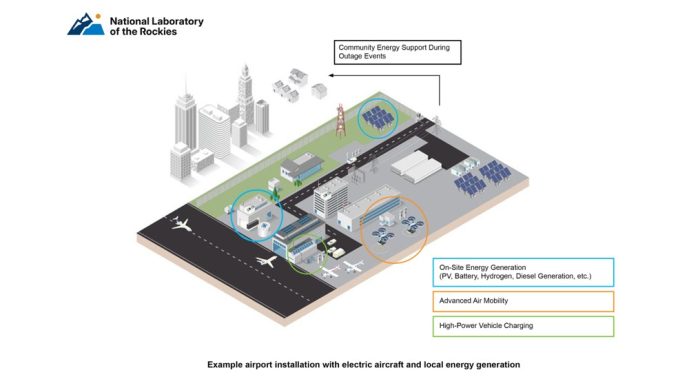
A new report has unveiled a “blueprint” for the electrical systems of small-to-medium airports as they prepare to support advanced air mobility aircraft.
The report, titled “Airports as Energy Nodes,” or ÆNodes, was one outcome of a partnership between NASA and the National Laboratory of the Rockies. It details how regional airports can meet the expected energy needs of electric and hybrid aircraft by using existing airport infrastructure and leveraging potential new on-site energy assets, hosted by airports to offset load growth.
To create the guide, researchers:
- Forecast advanced air traffic at multiple airports and under multiple scenarios
- Projected electrical demands from charging from various types of electrified aircraft
- Analyzed the grid interconnection potential for on-site generation
- Sized local generation installations based on available land area and the ability of the existing electrical infrastructure to support on-site energy generation
- Created a digital twin of a participating regional airport to determine the best placement of new energy generation assets and aircraft charging infrastructure.
As part of the analysis, researchers created an extension to the REOpt software tool, which identifies the optimal mix of energy, generation, storage, and advanced technologies to meet cost savings, resilience, and energy performance goal. The new tool, called REopt-Insight, provides airport operators with a more dynamic look at external factors such as energy escalation rates over time that provide key insights into making installation of new energy generation sources more viable.
Along with addressing expected load growth, the analysis also detailed a strategy where airports can generate more energy than they need and serve as “energy nodes” for their local communities by exporting excess energy in case of emergencies. In exchange for a modest cost increase of $0.01/kWh to $0.09/kWh for exported energy, the strategy can make new energy generation systems cost-neutral for regional airports.
Airports are encouraged to partner with the National Laboratory of the Rockies to develop detailed plans for supporting advanced aircraft.
In particular, the report authors write, using a digital twin provides an accurate sandbox to test the effectiveness of on-site generation sources: “It helps not only to determine the effectiveness of the energy generation system but also to answer questions such as where the generation resources should be placed, what electric meter to connect them to, and what, if any, network upgrades would be required to achieve the stated goal—all without buying a piece of equipment or breaking ground on construction.”
Access the full report online. Explore the National Laboratory of the Rockies’ aviation energy futures research to learn more.
Image from the National Laboratory of the Rockies