

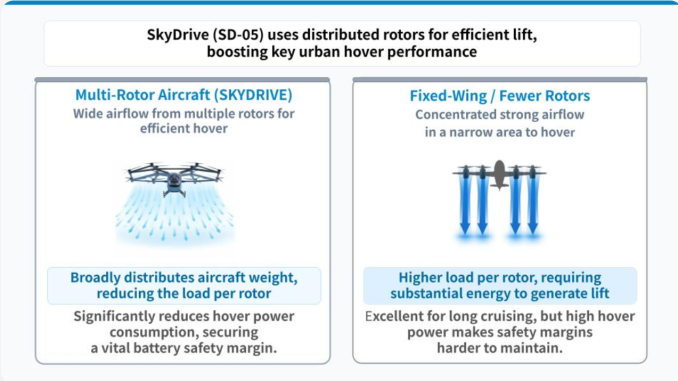
SkyDrive has published its Aircraft Design Concept paper “The eVTOL Safety Dilemma in Congested Urban Environments” which outlines the engineering rationale behind choosing a compact multi-rotor architecture specifically optimized for operating in space-constrained urban settings.
“In the emerging eVTOL industry, there is no single “correct” aircraft architecture for every application,” said the company in a press release. “Design choices range from winged aircraft (such as tilt-rotor or lift-and-cruise configurations) focused on long-range cruising efficiency, to multi-rotor aircraft optimized for the operation in limited spaces. This SkyDrive’s Concept paper examines the engineering trade-offs between hovering performance, battery power density, and redundancy—explaining why a compact multi-rotor is the most suitable architecture for inner-city mobility use.
Winged eVTOL configurations offer clear advantages for long-range flights by utilizing wings to generate lift during forward cruise, said the company. However, operating in dense urban environments presents different priorities. In confined city spaces surrounded by obstacles, precise vertical approach, low-speed handling, and hovering capability become paramount. Incorporating tilting mechanisms or fixed wings adds structural weight and complexity, which in turn increases the power required during hover. Balancing forward cruise efficiency with urban hovering safety represents the core engineering dilemma addressed in the paper.
“In urban environments lacking runways, hovering efficiency is critical. A key parameter defining this is “disk loading”—the ratio of maximum takeoff weight to total rotor disk area. Lower disk loading distributes aircraft weight across a larger rotor area, significantly reducing the battery power needed to hover. SkyDrive’s design incorporates 12 rotors to secure a large total disk area, achieving low disk loading and maximizing hovering power efficiency.”
When considering the performance of eVTOLs, batteries have two major critical factors, said SkyDrive. One is “energy density,” which indicates how much energy can be stored. This mainly affects the flight range. The other is “power density,” which indicates how much power can be supplied instantaneously. In hovering and vertical takeoff and landing, which require large amounts of power, this power density becomes essential. In aircraft with high disk loading, the required power also increases, and the battery’s power performance can become a constraint for vertical flight. In other words, for eVTOLs used in cities, it is important to look not only at “how far the battery allows the aircraft to fly,” but also at “how much power it can safely supply when needed.
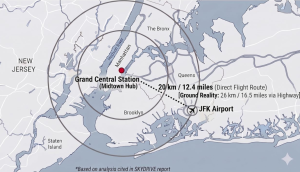
When considering aircraft safety, designs must be based on the premise that a failure will occur in part of the system. This Design Concept examines the redundancy of batteries and propulsion motors. “For example, even if a failure occurs in one of the battery packs, the remaining system alone must be able to continue safe flight and landing. A major hurdle here is the previously mentioned “power required for hovering.” In densely built urban areas where emergency forward-landing runways are unavailable, an aircraft must be able to complete a safe vertical landing even if a power system component fails. SkyDrive’s design addresses this requirement by maintaining low disk loading, providing the necessary power margin to ensure stable hover and safe vertical landing directly onto a vertiport, even in single-failure scenarios.”
Aircraft architecture is inherently sized by its most demanding flight phase: hovering. High disk loading requires an oversized, heavier propulsion system to achieve takeoff thrust, which significantly reduces the Payload-to-MTOW (Maximum Takeoff Weight) ratio—a weight penalty that persists even during forward cruise. For short-range urban travel (under 30 km), carrying heavy, oversized propulsion systems yields diminished returns. By optimizing the powertrain for hover through a low disk loading approach, SkyDrive minimizes total propulsion weight and maximizes payload efficiency.
For more information
https://skydrive.co.jp/en/news/72988/