

By Philip Butterworth-Hayes
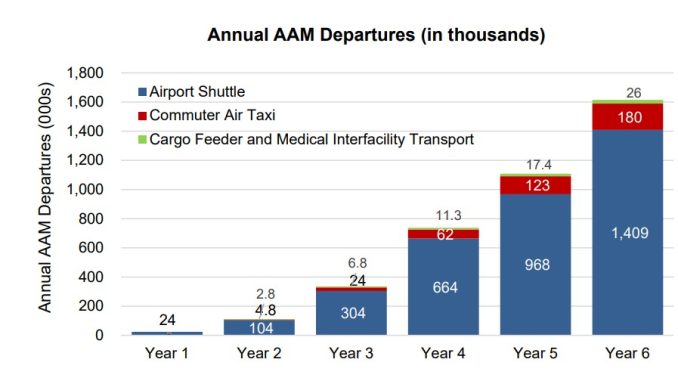
The Federal Aviation Administration is forecasting that by the end of year one of advanced air mobility (AAM) aircraft entering into service there will be a total of seven aircraft flying, operating 24,600 departures.
The FAA is forecasting each AAM aircraft would conduct 28 trips per day, on average (two trips per hour over a 14-hour operating day) – a very aggressive assumption according to most industry analysis

“The Airport Shuttle projections constitute the largest portion of the overall AAM forecasts for a couple of reasons,” says the FAA. “First, the Airport Shuttle is anticipated to be the initial AAM use case to be implemented, with demand increasing annually in tandem with the rise in airline passengers from the growing number of Metropolitan Statistical Areas that could adopt an AAM airport shuttle service. Secondly, the number and proportion of commuters likely to consider AAM are generally lower than the estimates for airline passengers. The fleet sizes required to support the projected departures for the four use cases were estimated by assuming each AAM aircraft would conduct 28 trips per day, on average (2 trips per hour over a 14-hour operating day) for the Airport Shuttle, Cargo Feeder, and Urban Air Taxi use cases and 2.5 trips a day for Medical Interfacility Transport use case. The projected NAS-wide AAM daily trips and the estimated fleet sizes to support those trips are shown in the table below. Based on announcements of expected fleet production capacities from several AAM OEMs, the fleet sizes needed to support the number of trips should be attainable and not be a constraining factor.”
“Among the three most-likely AAM use cases, it is projected that initial operations in the U.S. will commence with airport shuttles in a few major cities and cargo feeder operations in sparsely populated areas of the Western U.S. or among island communities, followed by air taxis, and then medical interfacility transport,” continues the FAA. ” This is because airport shuttles will have the most robust passenger demand traveling between fixed and concentrated points of interest (i.e., airports and downtown areas). Similarly, cargo operations already have established routes and infrastructure that AAM aircraft could replace the current operations. Urban air taxi flights for commuters, on the other hand, will be spread across more routes depending on where commuters live and work.”
Lastly, air medical interfacility transport is expected to lag airport shuttle and air taxi services due to a lower level of operator interest currently, as well as potential requirements for retrofitting aircraft for medical-use, additional time needed for aircraft certification, and deployment of charging infrastructure to support these operations.
For more information
https://www.faa.gov/data_research/aviation/aerospace_forecasts/2026_Emerging_Aviation_Entrants_Unmanned_Aircraft_Systems_Advanced_Air_Mobility-1.pdf