

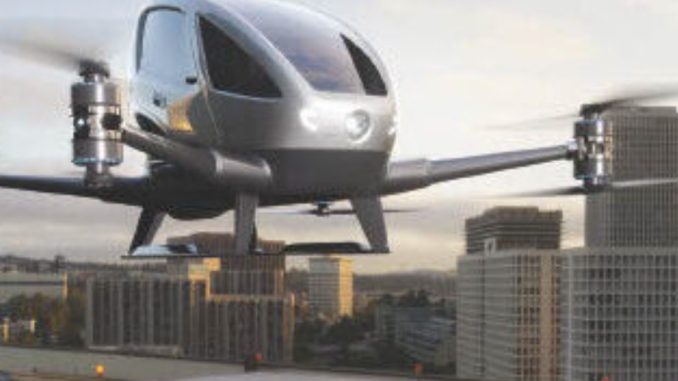
According to a new report by Valour Consultancy, “The Future of Advanced Air Mobility – 2026”, the in-service fleet of passenger electric vertical take-off and landing (eVTOL) air taxis will reach 6,824 by 2050.
According to report author Craig Foster, outside China, take-off and landing sites are expected to remain heavily concentrated in megacities across much of the Western world, where high disposable incomes will enable enough of the affluent population to adopt such services. “Landing fees are a significant component of cost per available seat mile (CASM) and, together with hugely expensive and frequent battery replacements, likely high insurance costs and pilot salaries, the long-touted Uber Black pricing model looks a distant prospect,” said Foster.
Valour’s forecast expects the fleet to remain predominantly China-domiciled over the course of the next 25 years, said the company in a press release. “China is already building vertiports at scale, which is not the case anywhere else. This, in addition to its uniquely centralised, top-down approach, generous subsidies supporting the development of its low-altitude economy, and platforms like EHang’s pilotless EH216-S being certified well ahead of overseas rivals, puts it leagues ahead of any other country when it comes to passenger eVTOL,” continued Foster.
The report highlights stronger potential in other advanced air mobility (AAM) segments, with Foster identifying regional air mobility (RAM) as a particularly compelling opportunity. “With more than half of today’s 4,000-strong sub-50-seat fleet expected to retire by 2040, there is a natural replacement window that aligns well with the entry-into-service timelines of leading electric conventional take-off and landing (eCTOL) aircraft. As many of these are hybrid-electric designs that can also fly from the tens of thousands of underutilised airports that already exist, the requirement for investment in new on-ground infrastructure is significantly lower,” he said.
Cargo drones also present viable near-term opportunities, particularly for industrial resupply where the incumbent option is typically a crewed helicopter that is both expensive and risky to operate at low altitudes. The first deliveries of AutoFlight’s CarryAll support this – with initial customers ordering the aircraft for offshore cargo missions. Delivery to remote and poorly connected communities, alongside growing demand for middle-mile logistics, will also drive growth in this segment, as will electric and hybrid-electric aircraft deployed on specialist missions like emergency medical services.
“Taken together, the report tells a story that extends well beyond the air taxi narrative that has attracted unprecedented investment over recent years.,” said Valour. “Indeed, Valour’s report forecasts a global in-service AAM fleet exceeding 19,500 aircraft by 2050 when RAM, cargo and specialist missions are added to passenger eVTOLs. Crucially, the report’s central takeaway is that these aircraft will largely complement – not replace – existing modes of transport such as helicopters and light jets. It suggests that although there is a genuine market out there, it is much more modest in size than the wildly optimistic projections that defined the early 2020s SPAC boom.”
For more information
(Image: Valour)