

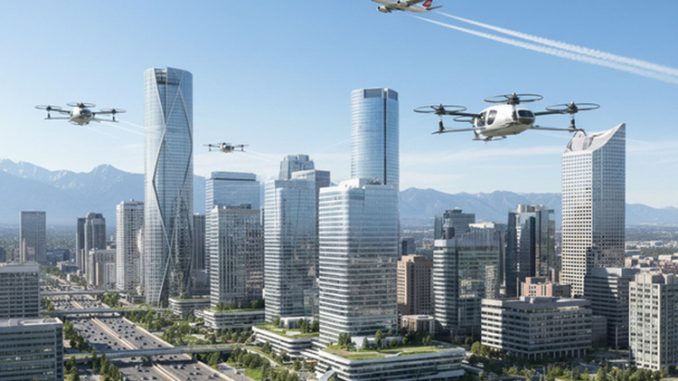
A new study commissioned by NAV CANADA forecasts that drones and other advanced air vehicles could add up to 120 billion dollars a year to Canada’s economy by 2045 and create more than 260,000 new jobs. NAV CANADA said this growth “signals a major shift in how we use the sky, as remotely piloted aircraft systems (RPAS) and advanced air mobility (AAM) become key drivers of innovation, safety and efficiency across many industries”. In 2024, RPAS and AAM operations generated between 2.4 billion and 3.6 billion dollars, supporting more than 30,000 jobs.
NAV CANADA said electric Vertical Takeoff and Landing (eVTOL) aircraft have the potential to enhance connectivity between urban, suburban and remote areas, reduce congestion and significantly lower carbon emissions. Potential applications in Canada include urban air taxis, regional cargo services, emergency medical transport and rapid-response missions in hard-to-reach locations.
“As we look ahead, the integration of RPAS and AAM into Canada’s airspace represents one of the most transformative opportunities in modern aviation,” said NAV CANADA’s Vice President and Chief Technology & Information Officer, David Sheppard. “It’s a shift that will require new technologies, new regulatory frameworks and deep collaboration across the industry, but the payoff is a safer, more connected and more innovative aviation system for all Canadians.”
The study predicts that by 2045, RPAS and AAM will perform more than 21 million annual flights, up from just 300,000 in 2024. Much of this expansion is expected to come from the transportation, construction and energy sectors.
“To enable this ecosystem, new digital and physical infrastructure will be essential, including vertiports, dedicated air corridors and integrated traffic management systems capable of safely coordinating thousands of AAM and RPAS flights in shared airspace,” NAV CANADA said. Early AAM projects and demonstration flights are already exploring these capabilities in Canada, supported by collaborations between industry, government, and NAV CANADA.
NAV CANADA acknowledges that integrating millions of uncrewed flights into the national airspace will require resilient digital systems, adaptive regulation and continuous collaboration between industry, government and communities.
For more information
Image: NAV CANADA