

By Philip Butterworth-Hayes
Two very important things have happened in the last few days in the global advanced air mobility industry, only one of which has received the attention it really deserves. The launch of the USA’s Advanced Air Mobility Strategy is a landmark event, providing much needed clarity on the relationships between different stakeholders and the role of central government in accelerating the AAM industry towards the goal of making the USA the world leader in automated flight.
This comes just a few days after China’s government announced the launch of the first stage of a national low level airspace traffic management system, to coordinate the management of both drones and eVTOLs in cities.
For both China and the USA AAM has for time been seen as strategic industry, requiring a joined-up approach among all stakeholders (including regulators and local authorities) with government funding available for critical areas of research.
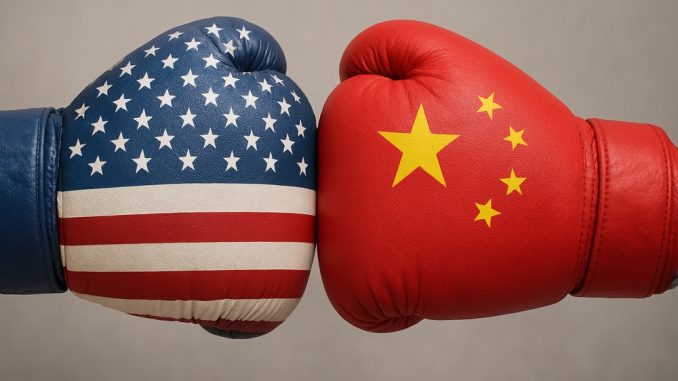
But for China and the USA the race to become the world’s AAM automatic aviation superpower is now entering a critical stage. The winner will be able to build airliners without pilots in the cockpit. And for both countries, there are vital military interests involved. As the drone war in Ukraine enters a new era of autonomous warfare (with the first engagements between autonomous air and ground systems being reported) the winner of the race to develop ever more capable, longer-range, more robust, larger eVTOLs will gain an important edge in both logistical supply and combat areas. For both countries AAM is far more important than just a race for commercial advantage.
And it is more than just an engineering race, too. One of the most important but misunderstood parts of this race will be the speed with which civil regulators gain the money and the skill sets required to support the journey from crewed aviation to autonomy.
As an Airbus blog (From Manned to Unmanned Aviation: a new frontier in risk analysis) of December 17 2025 elegantly put it:
“The transition from manned to unmanned aviation involves far more than simply removing the pilot from the cockpit; it demands a fundamental reinvention of our safety philosophies….the rigorous engineering of Particular Risk Analysis must now evolve to address a new spectrum of threats. This new safety framework relies on three distinct frontiers: containing violent physical impacts, managing internal energy releases and validating the drone’s cognitive logic. Mastering these diverse challenges is the key to building the trust that matches the safety legacy of traditional aviation.”
So one the key battles will be the way in which these two countries develop their safety strategies to balance accelerated AAM adoption with safety measures acceptable to the public, industry and government. It is a clash of aviation ideologies.
China is in a clear lead. Its first generation eVTOL, the EHang EH216-S flies without a pilot, though is not fully autonomous yet (it cannot now fully perform tasks independently, using AI, sensors, and data for self-decision-making). And it will be first in commercial operation. Which means China will gain a huge edge in understanding the potential and limits of eVTOL operations at scale, airspace and vertiport operations, actual battery performance and weather limitations. In China, too, drone and eVTOL operations are integral components of the “low airspace economy”; in the USA, there are uncertainties over where the boundaries lie between drone and eVTOL operations. In China, cities and regions, coordinated by government, are currently defining thousands of air routes and take-off and landing areas for both drones and eVTOLs. As China does not have a comparable general aviation industry to that of the USA – local airports and helicports will be the starting point for most eVTOL operations in the States – it can make infrastructure positioning decisions more quickly and the vast majority of first vertiports in China will be in cities.
The CAAC both regulates the market and directly oversees flight safety, providing a highly centralised regulatory system. Many in the West criticise the CAAC for a lack of transparency but there is no evidence that flight safety performance in China is any way less robust than in the USA. On the contrary. According to the latest 2024 rankings of ICAO’s Universal Safety Oversight Audit (accepting all comparisons are odious) China received a 90.19% score and the USA’s FAA 89.08%.
In the West, AAM has to be shoe-horned into legacy regulatory and standards frameworks which are not easily adapted to this new form of aviation (Are new digital flight rules required or can we adapt the current ones?). But many will argue that this is a good thing, because it is these frameworks which have ensured aviation’s remarkable record of safety over many years. The requirement for safety performance transparency – and acceptance by local communities – will be fundamental to the success of the industry in the West, even if it does mean the crawl-walk-run approach of the USA, rather than the walk-run-sprint approach of China, gets US eVTOLs to the starting line later than those in China.
The new US Advanced Air Mobility strategy is a clear indication that the USA is determined to cut China’s lead as soon as possible. The battle for low level airspace supremacy – which includes the banning of DJI drone by federal agencies – is now fully joined.
And the first indications of who might win will come next year, when both Chinese and US eVTOLs are due to start flight operations in the Gulf States of the Middle East.
The fact that I can write a statement like that shows just how different AAM is from conventional aviation. For although the US has yet to type-certify any eVTOL the concrete pilings for vertiports are currently being laid in Gulf state to support their imminent arrival. And there is no clear indication of real market demand or the real economics and systems resilience of long-term operations. No wonder so many grizzled helicopter pilots and engineers are shaking their heads in disbelief when they hear the words “advanced air mobility”.
But this can only happen when politics is the driving force, rather than normal economics, which can momentarily be brushed aside in special cases such as these. But not for long. Ultimately who will win the global AAM race will depend on the resilience and scalability of very different competing eco-systems in which eVTOLs are key but not the only components. China might be winning round one, but if the political impetus behind the US Advanced Air Mobility strategy can be maintained, round two is up for grabs.
(Image: Shutterstock)