

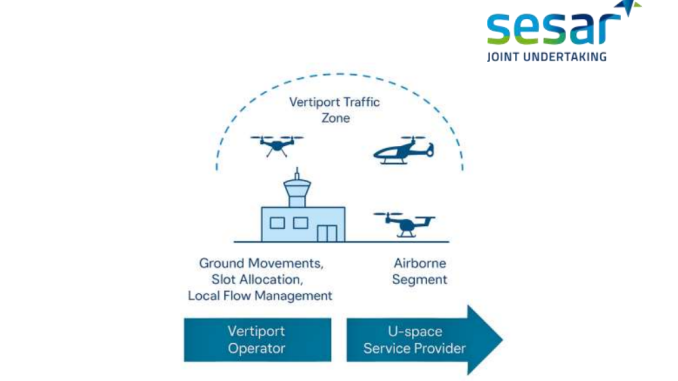
At the November 2026 European Union Drone Summit, members of the Single European Sky ATM Joint Undertaking (SESAR JU) published the latest concept of operations for European U-space concept (CORUS 5) which includes provisions for integrating vertically capable aircraft (VCA) or eVTOLs into European airspace.
A particular focus of the ConOps is integrating vertiport operations into the wider ATM network, along with demand and capacity balancing.
“VCA flight is currently expected to be organised to minimise holding or hovering. Vertiport operations should ideally enable an incoming VCA flight to land without any delay. To this end, landing is expected to be precisely organised before take-off. Continued Safe Flight and Landing is a capability of an aircraft to remain operable in the presence of system failures or adverse conditions. It is expected that VCA flight will include continuous planning of possible diversion. Hence, it is expected that Vertiports will continuously make known their availability to accommodate a landing, now and in the near future. This is the “Vertiport Information Service” VCA are expected to take off and land vertically from FATO. Some lack wheels and will require ground handling equipment to be moved. FATO will be occupied for a noticeable time before take-off or after landing, even if the VCA are usually at parking places.”
To enable safe vertiport operations, CORUS 5 sees an important role for the vertiport manager.
“The Vertiport Manager (VM) controls access to the Final Approach and Take-Off Area (FATO) of the Vertiport. The VM collects the information necessary to feed the VIS. If the Vertiport is at an airport or has a remote tower, Air Traffic Control are likely to be informed by the VM of the current and future state of the FATO. The level of automation of the vertiport manager is likely to be a balance between technical capabilities and the level of risk implied by the flights concerned. For passenger transport in the medium term, human oversight seems likely. “
Identifying potential traffic bottlenecks in the automated ATM system which could impact arrival times for eVTOLs at vertiports is another key area addressed within the ConOps and where further research is needed.
“U-space is characterised by reduced human intervention and the allocation of tasks to automated systems. Hence, it is expected that capacity limitations in the medium term are described in a manner that is consistent with the highly automated system that will manage such limitations, and which may not be easily interpreted by humans.. At the moment, it is not possible for this ConOps to explicitly state the precise indicators that may trigger the previous conditions (e.g. density of simultaneous flights, U-plan 4D volume size and granularity, level of proximity between flights).”
Costs for the traffic management system to support high density eVTOL operations has also been considered. End users should pay for the services they consume, and fees should not create barriers to U-space access or cost more than the operation they support, the ConOps states – but public money or new sources of revenue will probably be required in the early days to fund the traffic management system before scaleable revenue streams are created.
For more information
https://www.sesarju.eu/node/5548