

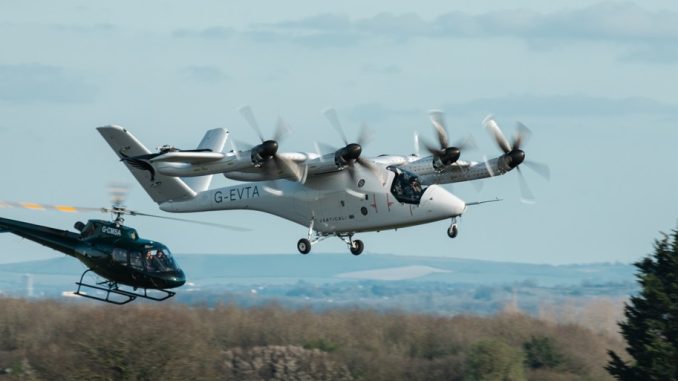
Vertical Aerospace today announced it has achieved piloted thrust-borne transition, taking off vertically like a helicopter and transitioning seamlessly into wingborne flight like a fixed-wing aircraft.
“This marks a first for a piloted, full-scale eVTOL aircraft of this class operating under the oversight of the UK Civil Aviation Authority (CAA), which is working in close collaboration with the European Union Aviation Safety Agency (EASA) toward certification of Vertical’s electric aircraft, Valo,” said the company in a press release.
“This is the most significant technical milestone in Vertical’s ten-year history and represents the completion of the first half of the two-way transition sequence,” said Vertical. “In two-way transition, the aircraft takes off vertically, flies on the wing, and then decelerates to land vertically — without the need for a runway, enabling seamless point to point flight from helipads, vertiports and rooftops.
On April 2nd, 2026, Test Pilot Paul Stone flew the transition sequence at Vertical’s Flight Test Centre at Cotswold Airport. The aircraft took off vertically before the front propellers tilted forward, enabling a smooth acceleration into wingborne flight as the rear propellers stowed, followed by a conventional runway landing.
This milestone was achieved concurrently with Vertical announcing an agreement in principle for a financing package of up to USD850 million on March 30th, 2026, to provide immediate capital and access to additional flexible capital as the company continues to progress towards type certification and the commencement of commercial operations, said Vertical.
Stuart Simpson, Chief Executive Officer at Vertical Aerospace, said: “This marks a turning point not just for Vertical Aerospace, but for the entire advanced air mobility industry. Achieving piloted thrustborne transition under active regulatory oversight – alongside the recently announced financing package – demonstrates that we have solved the hardest engineering challenges, have the regulatory relationships to complete certification, and now have the financial foundation to see this through to commercial service.”
(Image: Vertical Aerospace)
For more information