

By Kiran S Pillai, Founder, Vastuta Think Tank
India’s urban transport challenge is increasingly about time. Population growth, rising incomes, congestion and expanding metropolitan regions are putting pressure on roads, railways and conventional public transport. These systems will remain essential, but electric vertical take-off and landing (eVTOL) aircraft could provide another layer of mobility for selected high-value and time-sensitive journeys.
The original policy case for urban air mobility identified airport connectivity, medical transportation, regional connectivity, vertiports, digital airspace management, energy infrastructure and industrial development as important components of an Indian system. The next step is to examine where these systems could actually work economically.
India is likely to require several types of aircraft rather than one universal flying vehicle. Smaller battery-electric eVTOL aircraft could serve metropolitan routes, larger aircraft could support regional connectivity, and cargo aircraft could serve industrial and medical logistics. The key policy question is therefore not whether India should have flying taxis. It is where aerial mobility provides a measurable advantage over existing transport.
Routes that could work
A viable eVTOL route requires more than two geographically close cities. It needs congestion, high-value passengers or time-sensitive cargo, suitable landing locations, manageable airspace, sufficient demand and customers willing to pay for time savings. Airport connectivity is therefore one of the strongest initial applications.
Delhi-NCR is an important example. A CII study has examined a hypothetical corridor connecting Gurugram, Connaught Place and Noida International Airport at Jewar, demonstrating how AAM can be evaluated through travel-time savings, infrastructure, airspace and financing requirements. Mumbai could provide another major market because of its congestion, financial activity, airport locations and geographically separated economic centres. Potential corridors could eventually connect business districts with Mumbai and Navi Mumbai airports, although the region’s complex airspace would make safety and coordination particularly important.
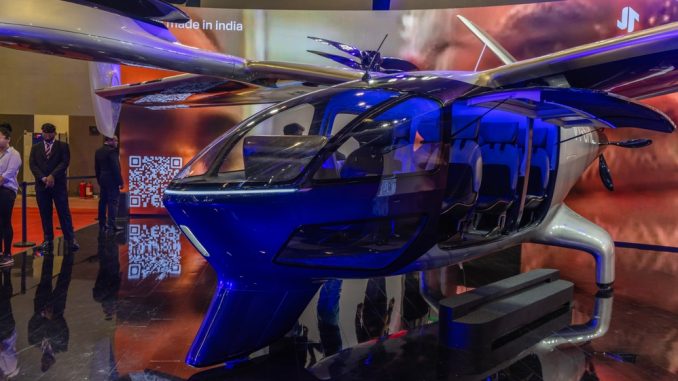
Bengaluru offers a third attractive environment because of its technology sector, congestion and aerospace ecosystem. Sarla Aviation is developing its Shunya eVTOL in Bengaluru and has progressed into formal certification activity there. Hyderabad and Chennai could become both operating markets and technology centres. Hyderabad has an emerging cargo-eVTOL ecosystem, while Chennai has strong aerospace, engineering and IIT Madras-linked capabilities.
Kerala presents a different opportunity. Its dense settlement pattern, road congestion, multiple airports, major hospitals and tourism industry make airport connectivity, medical transportation and tourism potential applications.
India could establish controlled demonstration corridors rather than allowing disconnected experiments across individual cities – perhaps along the lines of the US Federal Aviation Administration’s eVTOL Integration Pilot Program (eIPP), where there is a clear path between trials of aircraft, infrastructure and commercial operations.
Potential demonstration markets could include:
- Delhi-NCR — airport and business connectivity.
- Bengaluru — technology and airport connectivity.
- Mumbai — metropolitan and airport connectivity.
- Hyderabad — cargo and industrial applications.
- Chennai — aerospace and medical applications.
- Kerala — airport, healthcare and tourism applications.
Each corridor should measure travel-time savings, load factor, flights per aircraft, charging time, energy consumption, maintenance, noise, safety, passenger willingness to pay and operating margins.
India’s emerging eVTOL industry
India’s AAM ecosystem is beginning to move beyond conceptual proposals. Sarla Aviation is developing the Shunya eVTOL and received Design Organisation Approval from DGCA in 2026. The company has also announced partnerships involving aerospace engineering, certification and vertiport development. The ePlane Company, incubated at IIT Madras, is developing the e200X and is targeting applications including passenger transport, cargo and air ambulance operations. Its strategy is significant because it does not depend entirely on the conventional air-taxi market. BluJ Aerospace is developing cargo-oriented eVTOL aircraft, demonstrating another possible early market for Indian AAM.
International manufacturers are also important. Archer Aviation and InterGlobe Enterprises announced plans for an Indian electric air-taxi service and a potential fleet of up to 200 aircraft. However, the original proposed timeline demonstrates an important lesson: announcements should not be confused with certified aircraft or operational services.
Vertiports and infrastructure
Aircraft are only one component of AAM. India will require vertiports, charging systems, passenger facilities, maintenance areas, emergency systems, navigation infrastructure and connections to ground transportation. Location will determine economic viability. A passenger should not have to spend 30 minutes travelling by road to reach a vertiport for a 15-minute flight. Future vertiports could therefore function as mobility hubs rather than isolated landing sites.
Electric aircraft create a new infrastructure problem. Unlike conventional EVs, eVTOL aircraft may need rapid charging between multiple daily flights. The economics therefore depend on utilisation. Revenue per aircraft depends on the number of flights, passengers and average fare. But the number of flights depends on charging time, passenger turnaround, maintenance, weather and airspace restrictions.
Charging infrastructure is consequently not simply an electricity issue. It is a fleet-utilisation issue. Low energy costs do not automatically make an air-taxi operation profitable. Operators must account for aircraft development, certification, aircraft financing, vertiport construction, charging infrastructure, pilots, maintenance, insurance, software, staff, regulatory compliance and downtime. An aircraft flying only a few times a day could remain uneconomic despite low energy costs. A heavily utilised aircraft operating on a high-demand corridor could have a very different economics.
Medical and more general cargo transport are two potential early business models but large-scale AAM cannot operate as a collection of independent helicopter flights. Hundreds or thousands of low-altitude aircraft would require digital systems capable of identifying aircraft, managing routes, sharing flight information and preventing conflicts.
India’s existing drone ecosystem provides a foundation. Digital airspace and UTM systems developed for unmanned aircraft can potentially evolve alongside passenger-carrying AAM.
The next steps
India has already begun establishing the regulatory foundation for eVTOL operations. DGCA has developed certification guidance for VTOL-capable aircraft intended for Advanced Air Mobility, while guidance has also emerged around vertiports, pilot training and operations.
The next step should be a predictable national AAM framework covering aircraft certification, vertiports, pilots, maintenance, passenger safety, insurance, airspace, cybersecurity and commercial operations. India should establish a National Advanced Air Mobility Mission bringing together the Ministry of Civil Aviation, DGCA, Airports Authority of India, state governments, municipalities, airports, airlines, manufacturers, hospitals, energy companies and research institutions.
The mission should create a national AAM corridor map and establish common standards for aircraft certification, vertiports, charging, airspace, noise, emergency response, maintenance, insurance, cybersecurity and passenger protection.
But India should not view AAM simply as an aircraft-importing exercise.
The wider opportunity includes aircraft manufacturing, batteries, electric propulsion, power electronics, avionics, composites, flight-control software, UTM, simulation, charging, vertiports, maintenance and fleet-management systems. India’s automotive, electronics, software, drone and aerospace industries already provide capabilities that could feed into this ecosystem. This makes AAM potentially an industrial policy opportunity as much as a transportation opportunity.
India should not attempt to place flying taxis above every city. It should identify the routes where congestion creates significant economic value, the missions where time is worth paying for, and the locations where vertiports can be efficiently integrated into existing transportation networks.
The correct strategy is integration rather than replacement. Roads, buses, metros, railways and conventional aviation will remain the backbone of Indian mobility. eVTOL aircraft can provide another layer for journeys where speed, direct access and flexibility justify their higher cost. India’s AAM opportunity is therefore not fundamentally about flying cars. It is about identifying where the third dimension of transportation creates genuine economic value and building the aircraft, infrastructure, airspace systems, financing mechanisms and regulatory institutions required to capture that value.
(Image Shunya, India’s first electric flying taxi, by Sarla Aviation, is a sustainable, modular eVTOL designed for urban air mobility, capable of carrying passengers and cargo – Shutterstock)