

UK transport minister Heidi Alexander has highlighted the UK government’s new aviation priorities, including enabling routine Beyond Visual Line of Sight (BVLOS) drone flights and electric Vertical Take Off and Landing (eVTOL) integration, in a letter to Sir Stephen Hillier, Chair of the UK’s Civil Aviation Authority and seen by Urban AIr Mobility News.
The letter outlines what work the CAA will need to do to meet the government’s aviation priorities.
Broadly, the CAA will need to continue to develop the regulatory framework to support the growth of commercial and public sector use of UAS and eVTOL so that manufacturers and users have clear and proportionate pathways and standards for operations that can safely and securely operate at scale, according to the letter.
“This includes not only setting and communicating an enabling regulatory framework, but also fundamentally ensuring that safety and security standards are retained alongside innovation in aviation,” writes Heidi Alexander. “As part of regulating civil drones, the CAA will implement new standards and regulation, following the outcome of the regulatory review and the legislation that came into effect in January 2026. The CAA will also be the Market Surveillance Authority monitoring, enforcing and controlling drone products that enter the United Kingdom market.
“Where practicable, the fast approval of drone operations for hazardous tasks (such as inspecting railways, power lines and agriculture) will help keep to workers safe…The CAA can help the UK develop new low- and zero-carbon aviation technologies, such as zero-emission aircraft, through initiatives like the Hydrogen in Aviation Regulatory Challenge and helping to provide up-to-date carbon emissions data.
“During 2026/27 the CAA will enable:
- Atypical operations with multiple operators (such as multiple, consecutive, operations on the same length of railway). The CAA should expand the atypical air environments policy ingle operators to operate with less bespoke regulation and greater standardisation in complex urban environments (such as last mile delivery operations or between hospitals)
- Increasing integration of operations within specific areas of airspace
- Implementation of the Market Surveillance Authority for RPAS offering regulatory certainty and consumer confidence by end of 2026
- A significantly improved user experience for operators, underpinned by a more coherent interface with the industry. This should include clear end-to-end structures at the CAA that provide predictable and transparent timelines, unambiguous ownership of decisions and consistent expectations for applicants. A coordinated, cross-organisational approach to drone regulation and advisory functions that helps operators navigate requirements, maximises the likelihood of approvals, and supports the growth of a nascent sector. The approach should be informed by comparison with other regulators, including for example the US FAA’s UAS Integration Office.
- Implement processes that enable drone operators to progress approvals more quickly and consistently. This should include the CAA developing options on mutual recognition of flightworthiness assessments, as well as advancing positions on key policy – working closely with industry – including on multiple simultaneous operations and actively testing the Light UAS Certificate with UK operators. In addition, with Government funding support, the CAA will deliver a package of improvements to SORA. All these measures should be regularly reported against, and I expect to see demonstrable progress against them within six months.
In terms of eVTOL integration…”The CAA has created the regulatory framework by the end of 2028 and enabled the operational systems that allow initial commercial passenger Advanced Air Mobility flights (AAM) in the UK. During 26/27 the CAA will enable pathway trials to develop key policies on initial and continued airworthiness; pilot licensing; and AAM aerodromes. Alongside, and learning from these pathway trials, during 2026 the CAA will respond to its policy consultation on rulemaking, providing the emerging sector greater clarity on its approach. CAA will also provide to the Department for Transport (DfT) by the end of 2026 its Opinion and Instruction Document for eVTOL, setting out the legislative changes it recommends DfT implement in 2027 to enable eVTOL operations by 2028.”
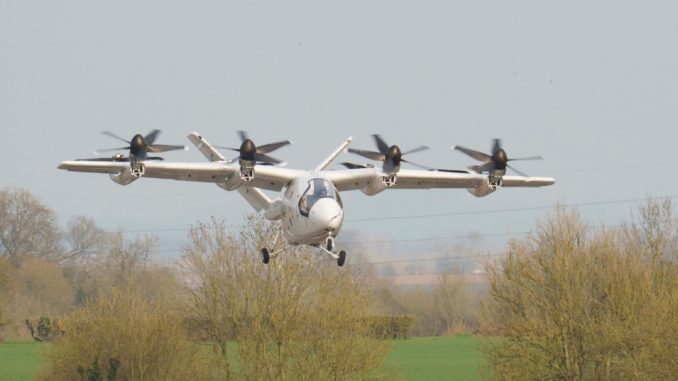
(Image: Vertical Aerospace)