

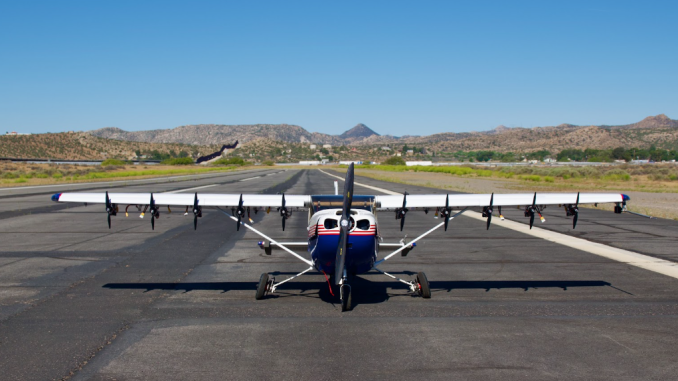
Wayfarer Aircraft today announced the successful completion of its NASA Phase II Small Business Technology Transfer (STTR) project that demonstrated the performance of the Waylift system. Waylift is a patented retractable Distributed Electric Propulsion (DEP) system. The propulsors deploy for takeoff and landing to generate high lift, then retract fully into the wing for efficient cruise flight. The system is designed to be compatible with existing, already-certified airframes rather than requiring a clean-sheet aircraft design, said the company.
The system was installed on a one-third-scale Cessna 182 with full‑scale‑representative aerodynamics to validate key performance metrics. The project was awarded under NASA STTR Topic T15.04 in January 2024 and closed out in July 2026.
“Wayfarer designed, modified, instrumented, and flight tested a one-third-scale Cessna 182 technology demonstrator,” according to a company press release. “Flight test results validate key capabilities, including: four times the lift of the unmodified baseline aircraft, exceeding preflight predictions; 40 percent less thrust required than typical Distributed Electric Propulsion systems at equivalent lift, a benefit that matched computational predictions and yields a lighter system with better landing performance; good handling qualities, demonstrating the feasibility of modifying existing aircraft for ultra-Short Takeoff and Landing (STOL) performance.”
“The question going into Phase II was whether a propulsor you can stow inside the wing could still deliver the high-lift performance of a pylon system. It can, and it does it with substantially less thrust,” said Byron Ward, CEO of Wayfarer. “We were also able to fly the exact same airframe back-to-back with and without the system, demonstrating how the technology can be retrofitted to upgrade existing aircraft. The airplane flew very well without any design changes needed to accommodate the Waylift system.”
Wayfarer worked with researchers at Embry-Riddle Aeronautical University’s Eagle Flight Research Center (now the Center for Advanced Air Mobility) to develop the technology demonstrator’s propulsion and flight control systems. Embry-Riddle also flight tested its instrumented full-scale Cessna 182 to validate that the subscale aircraft aerodynamics were full-scale-representative.
“This system is the first of its kind to provide the ultra-STOL benefits of a blown wing with Distributed Electric Propulsion while also stowing away during cruise flight — it’s a game changer,” said Dr. Kyle Collins, an assistant professor in Embry-Riddle’s Aeronautical Science Department who collaborated on the research and testing. “Running the subscale and full-scale campaigns side by side shows the results apply at full scale.”
The system is designed to cut required field length by 80 percent, enabling aircraft to deliver thousands of pounds, thousands of miles while operating to and from unprepared sites no larger than a football field.
“Waylift gives our military essential contested logistics capability with long-range delivery directly to the point of need, even in remote environments where runways are vulnerable or nonexistent,” said Ward. “And it can be fielded rapidly, because Waylift upgrades proven aircraft with millions of fleet hours worldwide.”
For more information
ward.aero
(Image: Wayfarer)